Migrate from Shotstack without rewriting your JSON
Run the JSON you send to Shotstack through migrate() in the Rendobar SDK and render the same video on Rendobar Compose. Every field that changes comes back by its path.
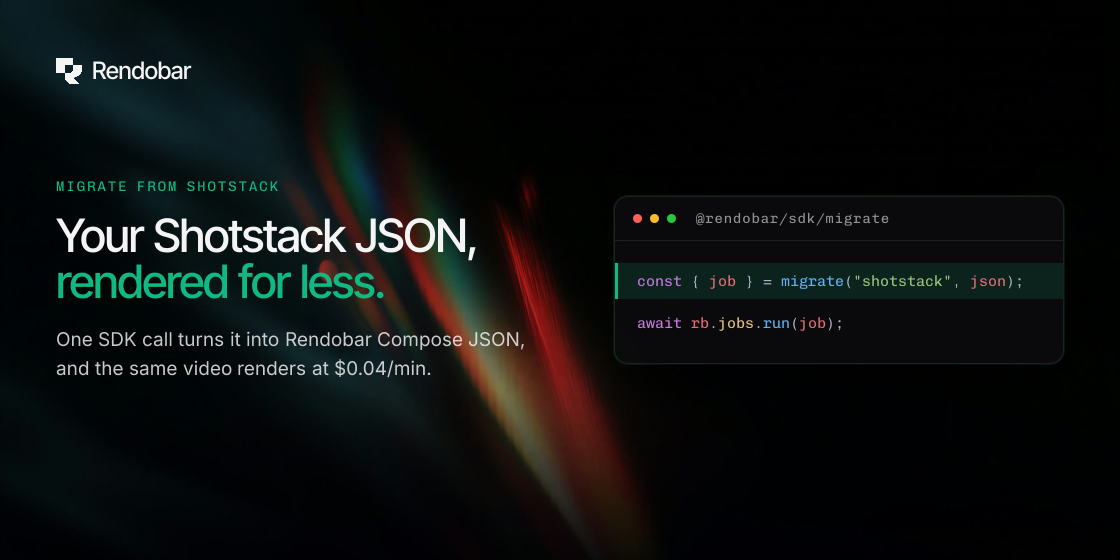
migrate() in @rendobar/sdk/migrate turns the JSON your code sends to Shotstack into Rendobar Compose JSON. It runs in your own process with no network call, so you can convert on every render or convert your templates once and store the result.
import { createClient } from "@rendobar/sdk";import { migrate } from "@rendobar/sdk/migrate";
const rb = createClient({ apiKey: RENDOBAR_API_KEY });
const { job, diagnostics } = migrate("shotstack", shotstackJson);if (!job) throw new Error("Could not convert, see diagnostics");
const result = await rb.jobs.run(job);- What carries over. Tracks and timing, video, images, audio, text and fonts, transitions, Ken Burns moves, filters, crops, speed and chroma key.
- What changes. Anything that renders differently comes back in
diagnostics, with its path in your JSON and a code that stays the same between versions. - Merge fields and n8n. A merge field becomes a typed variable with its sample value. The body of an n8n HTTP Request node converts with its expressions left in place.
The converter’s numbers come from renders on Shotstack’s sandbox, not from its docs. Its fades run 1, 2 and 0.5 seconds, its Ken Burns presets zoom to 1.1x, 1.3x and 1.7x, and its wipes hold for a quarter of a second before sweeping across in 0.3 seconds, so migrate() rebuilds each one to match. Migrate from Shotstack plays one timeline rendered on both APIs, with what each render cost.
Every API we compare also has an alternatives page, listing only the APIs that do the same job: JSON video APIs and FFmpeg APIs. The Compose docs describe every field a converted job contains.
Shotstack is the first converter. More video APIs are coming to the same migrate() call, so if you need one moved, tell us which at hello@rendobar.com.